Bastei Bridge: A Complete Guide to Saxon Switzerland's Iconic Viewpoint
History, viewpoints, how to get there from Dresden and Prague, parking, opening times and the best time to visit the region's most famous landmark.
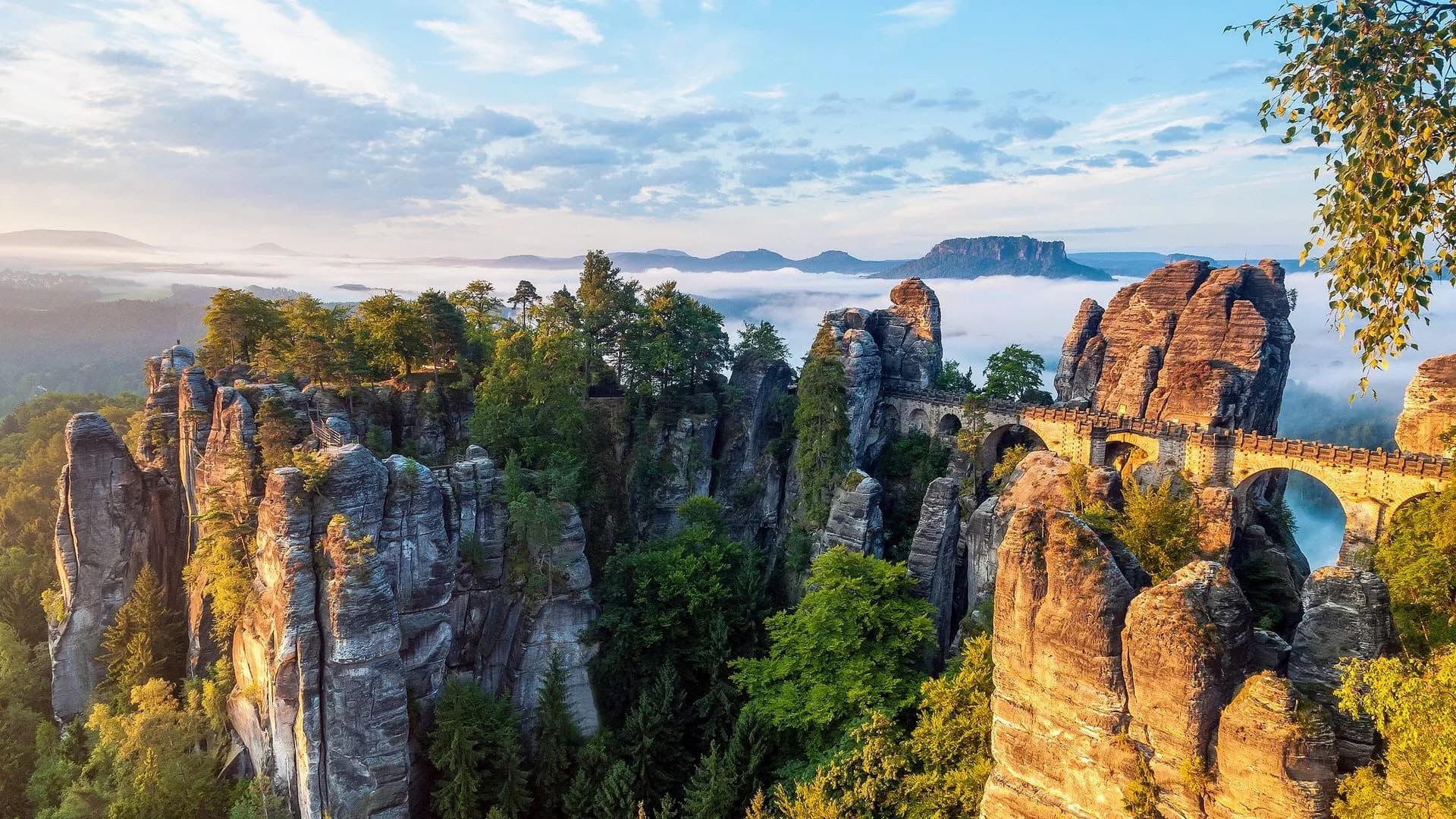
The Bastei Bridge connects sandstone towers high above the Elbe in Saxon Switzerland. From the stone bridge and nearby viewpoints, you can look across the Elbe canyon towards Lilienstein mountain and Königstein Fortress. It is one of the most memorable stops on our day trips through the region.
In short: the bridge is free to visit and normally accessible year-round. Allow roughly 45 minutes of driving from Dresden, plus time for parking and walking. Early mornings tend to be quieter than midday.
Want to combine Bastei with the Czech side of the region? Our small-group day trips from Dresden and Prague include hotel pickup, a local guide and a Czech lunch. Choose your departure city to see the itinerary and available dates.
Visit Bastei on a guided day trip
Enjoy the views and explore more of the region, with hotel pickup, a local guide and a Czech lunch included. Choose your departure city.
A 19th-century landmark above the Elbe
The first bridge here was a wooden structure, built in 1824 to connect the rocks for early visitors and to reach the Felsenburg Neurathen, the largest medieval rock fortress in the region. As the area grew into one of Germany's earliest tourist destinations, the wooden crossing was replaced in 1851 by the stone bridge that still stands today.
The landscape itself was made famous by the Romantic painters of the early 1800s, who came to paint these sandstone formations. Walking across the bridge, it is easy to see why — the scene has changed very little since.
The view from the Bastei
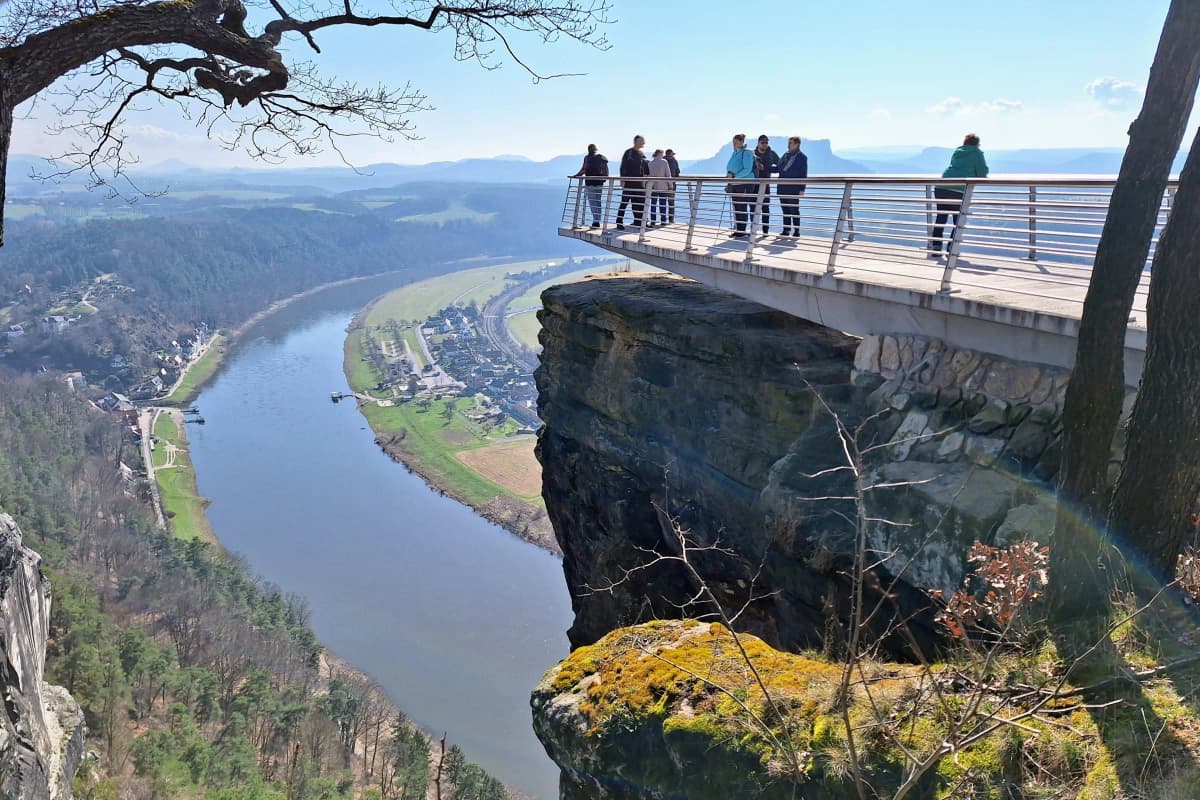
The bridge connects several viewing platforms set among the rock towers. The main viewpoint looks down into the Elbe Canyon, with the flat-topped Lilienstein on the far bank and the Königstein Fortress in the distance.
For the classic photograph — the one of the bridge itself, set between the pillars with the valley below — head to the Ferdinandstein viewpoint a short walk away. It is the angle you have probably already seen, and it shows the full scale of the rock formation far better than standing on the bridge does.
How to get to the Bastei Bridge
The Bastei sits near the village of Rathen, about 40 km southeast of Dresden.
From Dresden it is roughly a 45-minute drive; from Prague allow about 2 hours, depending on traffic. Add time for parking and the walk to the bridge.
By car, you can use the nearer Parkplatz Bastei, with a short, mostly level approach to the bridge. The larger P+R Bastei is farther from the bridge, beside the main road between Lohmen and Rathewalde at roughly the same elevation. A shuttle bus connects it with Bastei. The nearer car park can fill quickly on summer weekends.
By public transport, take the S1 to Kurort Rathen, cross the Elbe by passenger ferry and continue uphill on foot. The climb from Rathen includes steps and is more demanding than the approach from the car park near Bastei. Allow for the ferry wait and the climb as well as the train journey.
Opening times and entrance fee
You do not need a ticket for the Bastei Bridge; access is free. It is normally accessible year-round, although weather or temporary closures may affect individual paths. The Neurathen Rock Castle is currently closed until further notice. This does not affect the route across the Bastei Bridge.
The best time to visit
Early morning and late afternoon usually offer a quieter visit and softer light for photographs; midday tends to be busiest. Autumn brings golden woodland, while snow can transform the landscape in winter. Stone steps may be icy in cold weather.
Visiting the Bastei Bridge on a guided day trip
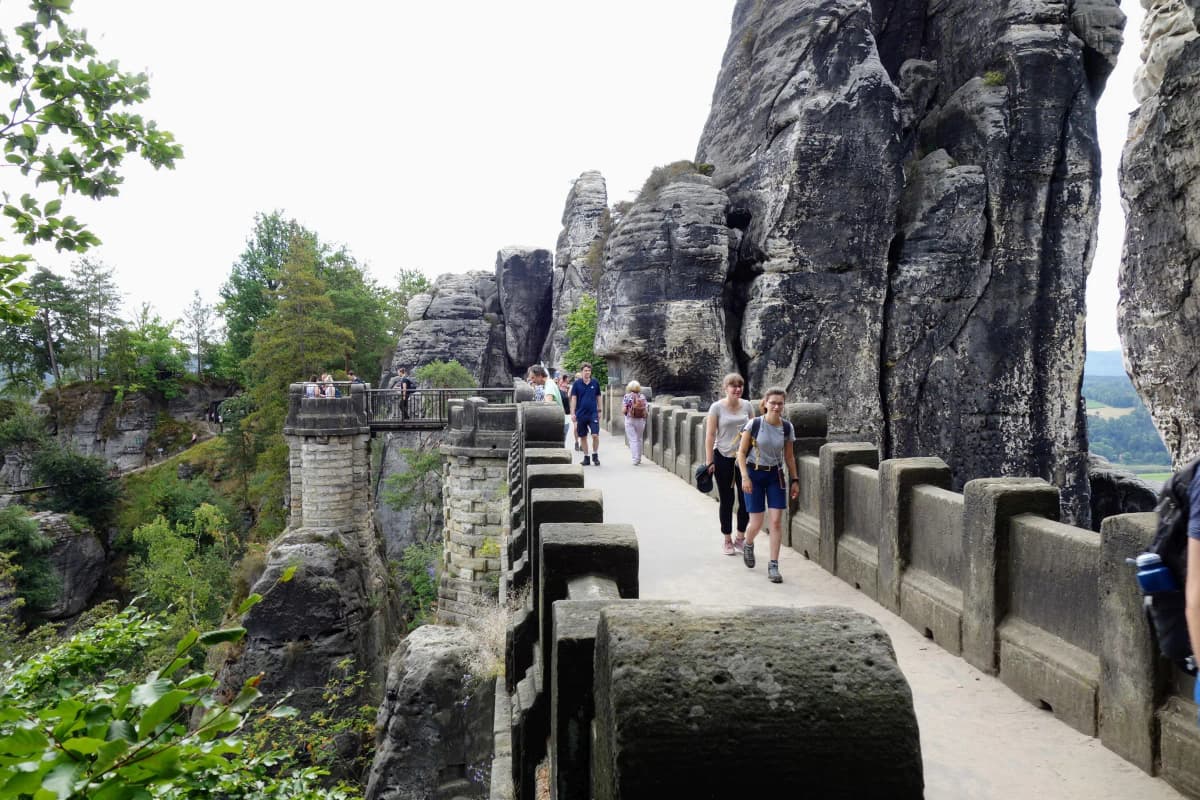
Bastei is the least demanding part of our day trip: from the nearby car park, it is a short, mostly level walk to the bridge. We then continue by minivan to the other stops, exploring both the German and Czech sides of the region in one day.
From April to October, we combine Bastei, Pravčická Gate and the Tisa Rocks of Narnia fame. Expect around 9–10 km of walking across the day, including the climb to Pravčická Gate. For a closer look at the stops and how the day unfolds, read our detailed guide to the day trip from Dresden.
Ready to join us? Choose the tour from Dresden or the tour from Prague to see available dates.
Winter trips: Bastei and the Tisa Rocks
In winter, we focus on two stops: Bastei and the Tisa Rocks, without Pravčická Gate. With shorter daylight and colder weather, this leaves time to enjoy both places at a comfortable pace and stop for a warm Czech lunch. Choose a winter tour from Dresden or from Prague. Snow depends on the weather and is not guaranteed.
A stop between Prague and Dresden
Travelling between Prague and Dresden? You can also visit Bastei on our private sightseeing transfer. More in our Prague to Dresden transfer guide.
Frequently Asked Questions
Where exactly is the Bastei Bridge?+
In the Saxon Switzerland National Park in Germany, near the village of Rathen — about a 45-minute drive from Dresden and roughly 2 hours from Prague.
Is the Bastei Bridge in Germany or Switzerland?+
In Germany. "Saxon Switzerland" is the name of the region, given by 18th-century Swiss artists because the landscape reminded them of home — it has nothing to do with the country of Switzerland.
Is there an entrance fee?+
You do not need a ticket for the Bastei Bridge; access is free. The Neurathen Rock Castle is currently closed until further notice, but the route across the bridge is not affected.
Can I visit the Bastei Bridge without a car?+
Yes. Take the S-Bahn to Kurort Rathen, cross the Elbe by passenger ferry, and walk up — or join a guided tour with hotel pickup if you would rather skip the logistics.
How long should I spend there?+
Most people spend 1–2 hours at the bridge and viewpoints. Combined with the rest of the national park, it makes a full day.
Can I visit in winter?+
Yes, the bridge is normally accessible year-round, but steps can be icy and individual paths may temporarily close. Our winter tours combine Bastei and the Tisa Rocks, without Pravčická Gate. Snow is not guaranteed.
Was the Bastei Bridge in the Narnia film?+
No — a common misconception. Bastei does not appear in the film. The genuine filming locations in the region are Pravčická Gate and the Tisa Rocks, as covered in our guide to the Narnia filming locations.
Visit Bastei on a guided day trip
Enjoy the views and explore more of the region, with hotel pickup, a local guide and a Czech lunch included. Choose your departure city.